Monday, October 2, 2023

Share of Young Adults Living with Parents Highest in 80 Years


The percentage of young adults that live with their parents is higher now than at any time since the Great Depression of the 1930s.  Almost one in two now live with parents.

The inability of young people to form their own households is a long-term negative for American society.

Moving out of one’s parent’s home is an important marker on the road to independent adulthood.

But today, young people are finding it difficult to strike out on their own. 

Young people were harder hit than older Americans from job and income losses from the COVID lockdowns.  Now they’re facing an unstable job market, the hangover from the high cost of college and student debt, and falling income in real terms.

However, the biggest barrier to independent living is probably sky-high rental and housing prices.


Marriage and family are for most people a source of personal happiness and a fulfilling life.

The inability of young people to form their own households will inhibit marriage and birth rates.  Married couples want their own space and to live their lives outside of parental authority.  Unaffordable rents and home prices are causing young people to delay getting married and having children.

Though marriage rates and average family size have declined over the past fifty years, Americans still want the joys of family life. 

In fact, the percentage of Americans that view three or more children as ideal in 2023 is higher than at any time since the start of the 1970s.  According to Gallup, almost 50 percent of Americans view three or more children as ideal.  Only 2 percent of Americans view zero children as ideal.


The early years of adulthood are a critical time in our lives.  Until now, it is the stage of life in which so many important life decisions are made.

High housing costs and a bad economy limit the flexibility of young Americans to explore life’s possibilities including those concerning marriage and family and to make those choices that produce the greatest happiness and fulfilment in the long-run.


Monday, August 21, 2023

Gen Z on the Move


New report from the consulting firm Oliver Wyman has lots of interesting data on what young people in the United States and the United Kingdom look for in a job.  

An astonishing 62 percent of Gen Z workers are at least passively looking for a job as are 60 percent of Millennials (graphic below).  


Some other key findings

- Young people today are twice as likely to struggle with mental health issues as older workers.

- 41 percent of men and 48 percent of women have a side hustle of some sort whether it be a second formal or informal job.  

A key takeaway form the study is that young people want flexibility.  As I point out in my own research, the rigid environment of unionized workplaces is unlikely to provide the flexibility that young people need.

The United States should be freeing up workers, not forcing them into rigid employment relationships.  This is a big problem for the Democratic party as it pits one of their most important voting blocks (younger people) against one of their main funders (labor unions). 

Friday, August 18, 2023

The Economic Plight of Chinese Youth Demonstrates Yet Again That Socialism Doesn’t Work


Surveys show that roughly half of the young people in America have a positive view of socialism.  Yet socialism has failed everywhere it’s been tried. 

Typically, it is young people that are harmed the most by socialist economic policies.  The economic plight of young people in China is just one recent example.

If there’s anyplace that socialism should work for young people, it’s China.  China economy has been centrally planned and managed since1949, longer than any other nation on earth. 

Yet young people in China are having a difficult go of it.  Jobs are scarce, youth unemployment high. 

It’s so bad in China cities that young people have begun sharing beds with strangers just to make ends meet.  Young Chinese call this “hot bedding”. 

Hot bedding with a stranger is not a good thing.  It’s the kind of thing you might have seen in a Three Stooges short, not a romantic rendezvous. 

Hot bedding has come common because job opportunities for young people in China are so poor and rents so high.   

Below is China’s youth unemployment series for the last five years as reported by the New York Times. 


By comparison, the youth unemployment rate in the United States is 8.7 percent.

Notice that the unemployment rate for older Chinese has actually ticked down a bit over the last five years.  Why is rising unemployment in China a more widespread phenomena?

Simple.  Patronage and work rules in China protect more senior workers with greater political connections.  The Chinese have a name for that: The Iron Rice Bowl. 

That works out great for older workers.  They have lifetime sinecures. 

But when the economy slows, as it has in China, someone has to bear the downside. 

Instead of sharing the risk of job loss throughout the workforce, patronage places all of the downside risk on younger people. 

Because of their relatively short tenure in the workforce, younger workers and new entrants have had fewer opportunities to acquire political connections within their own organization.  Note that I’m not using “political” in the ideological sense.  Rather “political” refers to relationships which may involve the local Communist Party apparatus, or it could just be relationships with influential managers and other employees.

Union seniority rules in the United States work the same way.  They protect the jobs of some but they also place the entire risk of job loss on younger workers with fewer years of experience.

To make matters worse, the Chinese government has decided to cover up the youth unemployment problem by discontinuing publication of youth unemployment statistics. 

In socialist economies, governments have more control over everything including the media. 

Control of the media allows the ruling party to squelch any news that makes the ruling powers look bad. 

That’s exactly what’s happening in China.  As the Chinese economy slows, inconvenient economic data series disappear.

This week China announced that it was no longer going to publish the youth unemployment rate.

That doesn’t solve the problem.  That just covers it up.  


Despite so much evidence on the failures of socialism, large numbers of young Americans are sympathetic to socialist ideas.  Many even endorse communism.

A recent survey found that 49 percent of Gen Z had a favorable view of socialism and a third supported the gradual elimination of capitalism in the United States.   

18 percent of Gen Z and 13 percent of Millennials think communism is a fairer system than capitalism and deserves consideration in America.

As Marion Smith, the Executive Director of the Victims of Communism Memorial Foundation put it, the findings of the survey demonstrates “a total failure of our education system, not just in schools but also a basic dishonesty in our media and popular culture. When one-in-four Americans want to eliminate capitalism and embrace socialism, we know that we have failed to educate about the historical and moral failings of these ideologies.”

 Indeed.

Thursday, August 17, 2023

New Survey Shows Gen Z is Remarkably Career Focused


There's a new survey on the career goals and higher education needs of Gen Z high schoolers out from Question the Quo.  The results show that younger Americans are very much focused on their careers and the practical education requirements necessary to achieve those goals.  

Findings were published in June 2023.  Fieldwork was done in January 2023.

Some high level takeaways from their January 2023 survey.  

- 65 percent think that some education after high school is necessary however 52 percent are considering a four year college, down from 65 percent in their February 2020 survey.  The letter follows a general decline in perceived value of a four year college experience and degree among the general population.

- Interest in community college, on-the-job training and career and technical education are all up from February 2020.

- Students eel unprepared for the next step.  Only 13 percent feel prepared for their next step after high school.  

- 63 percent say that they need more guidance on managing their finances.  

I personally am a big advocate for financial education.  There was a bill put forth in the Wisconsin legislature that would require some form of financial education in high schools.  Unfortunately, that bill was not enacted.   

- 53 percent want more formalized learning throughout their lives, up from 46 percent in 2021.  

Opportunities for formalized learning throughout one's career are important.  

My own view is that the Baby Boom generation, of which I am a part, was not good (or motivated) to develop others.  The Baby Boom was a large generation.  When generations are large, there's more competition for opportunities.  

The jobs website Indeed points out the competitive nature of the Baby Boomers.         

Up and coming generations are smaller and more interested in getting along rather than getting ahead.  This has virtues as well as drawbacks.  Nevertheless, successful employers need to meet their workers where they are and adapt to their desires.  Opportunities for life-long learning are one such area where employers need to step up their game.  


Friday, August 4, 2023

#Bidenomicsfail: Just 1 in 3 Gen Zs Say They Can Handle a $400 Emergency Expense


Joe Biden wants us to think that the economy is doing great.  In fact, the Biden economy has large numbers of Americans living on the edge. 

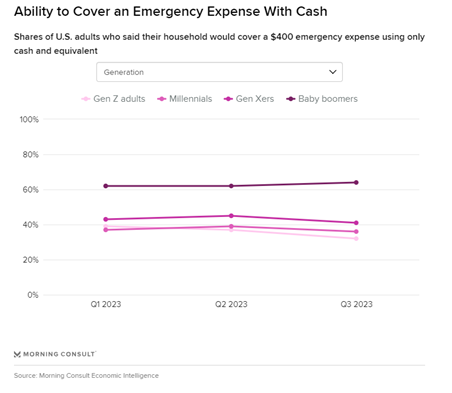
Morning Consult survey found that only 32 percent of Gen Z report that they could pay for an unanticipated emergency expense with cash.  Just two quarters ago, 39 percent of Gen Z could handle a $400 emergency expense. 

The normal pattern of saving over one’s lifetime is that as one ages holdings of financial assets should grow as one saves for retirement. 

However, the Morning Consult survey shows that Millennials and Gen X are making very little progress in building wealth.  

The survey found that only 36 percent of Millennials and 41 percent of Gen X said that they could handle an unanticipated $400 expense.  These percentages are not materially different from Gen Z. 

Seen differently, Gen Xers are now more than twenty years into their adult lives and their finances are not much more stable than the finances of new college graduates. 


The survey also asked whether the $400 expense would require putting off payment of other bills.  38 percent of Gen Z and 39 percent of Millennials and Gen X would have to put off payment of other bills. 

It’s not just Americans.  A video posed by TikTok user Simone (@simonesdays) shows how after paying taxes and bills, the paycheck from her CAD75,000 corporate job leaves her with exactly in $80 spending money for the next two weeks. 

Her TikTok video has been viewed 2.7 million times and has 184,000 likes as of Friday the 4th. 

Here are some of the comments on her TikTok page from other young people struggling to get by. 


At the core of the financial struggles of young A


mericans is a lack of economic opportunity.  The inability of the Millennials and Gen X to improve their finances so that they are closer to the Baby Boomers than Gen Z is particularly concerning.

Tuesday, August 1, 2023

Debt Tsunami Causes Fitch To Downgrade America’s Credit Rating


Fitch ratings announced that it has downgraded the credit rating of the U.S. government from AAA to AA+  Every American is going to pay for Washington’s irresponsibility though higher taxes and higher interest rates. 

Fitch’s announcement of their rating change highlights the massive amount of borrowing by the Biden Administration in addition to the decades of fiscal irresponsibility and governance failures in Washington and many state capitals. 

In Fitch's view, there has been a steady deterioration in standards of governance over the last 20 years, including on fiscal and debt matters, notwithstanding the June bipartisan agreement to suspend the debt limit until January 2025. The repeated debt-limit political standoffs and last-minute resolutions have eroded confidence in fiscal management. In addition, the government lacks a medium-term fiscal framework, unlike most peers, and has a complex budgeting process. These factors, along with several economic shocks as well as tax cuts and new spending initiatives, have contributed to successive debt increases over the last decade. Additionally, there has been only limited progress in tackling medium-term challenges related to rising social security and Medicare costs due to an aging population.

Fitch projects that Biden’s spending will blow the top off U.S. debt levels.  Interest on the debt will consume 10 percent of all government spending by 2025.  Interest rates are going to be higher making it even more difficult on young Americans afford a home. 

Fitch forecasts a [general government] deficit of 6.6% of GDP in 2024 and a further widening to 6.9% of GDP in 2025. The larger deficits will be driven by weak 2024 GDP growth, a higher interest burden and wider state and local government deficits of 1.2% of GDP in 2024-2025 (in line with the historical 20-year average). The interest-to-revenue ratio is expected to reach 10% by 2025 (compared to 2.8% for the 'AA' median and 1% for the 'AAA' median) due to the higher debt level as well as sustained higher interest rates compared with pre-pandemic levels.

The response from the Biden administration has been predictable.  Hit the snooze alarm and spend, spend, spend. 

S&P downgraded the U.S. in 2011 and China’s Chengxin International Credit Rating service downgraded the U.S. in May of this year. 

Tuesday, July 25, 2023

Canada’s Conservatives Are Attracting Gen Z Voters. What Can Republicans Learn from Them?

The Republican party lags far behind the Democrats in attracting young voters.  What is the Canadian Conservative Party doing right and the Republican Party doing wrong? 

Polling data from Canada shows that the Conservative Party has a significant lead among Gen Zs and Millennials over Justin Trudeau’s ruling Liberal Party. 

A June 2023 Ipsos poll puts Pierre Poilievre’s Conservatives at 37 percent overall compared top 32 percent for the Liberal Party. 

Importantly, Conservatives are ahead among Canadians of every generation. 

Conservatives have an 18 point lead over the Liberal Party among Gen Z and a 1 point lead among Millennials. 


This is enough for a huge swing in Canadian politics.  Like the United States, Canada has a first past-the-post electoral system control requires only winning the most seats, not a majority of the overall vote since Canada has a multiparty system.  Trudeau’s ruling Liberals only got 33 percent in the last Canadian federal election but that was sufficient to form a governing coalition.   

Contrast that with the United States.  Sixty-five percent of voters 30 and younger voted for the Democrats in 2022, up from 62 percent in 2020. 

Young voters were the key to the Democrats maintaining control of the U.S. Senate in 2022.  Were it not for younger voters, Republicans would now control both houses of Congress. 

Young people are fed up with Joe Biden, Nancy Pelosi and the relics governing our country.  A New York Times survey found that only one percent of 18 to 29 year-olds strongly approve of the job that Joe Biden’s been doing.  That’s one percent. 

Yet the Republican Party badly trails among younger voters and has no identifiable plans or strategy for outreach to twenty- and thirty-somethings. 

For a glimpse at what Canadian Conservatives are doing right, here’s Jordan Peterson’s interview with Pierre Poilievre


Lesson 1: Communicate.  Notice how clearly and calmly Poilievre speaks.  Contrast that with Joe Biden’s mumblings or Kamala Harris’s word salads.  Bureaucratic speak and empty talking point won’t do it.  Younger voters want leaders that communicate in language the average person can understand. 

Lesson 2: Have principles.  Poilievre’s statement on the importance of the free market is more forthright than anything that’s come from a Republican politician since Ronald Reagan.  The Republican Party needs candidates that can speak to free market economics or other conservative ideals with the same passion as Mr. Poilievre. 

Lesson 3: Be for change.  Poilievre clearly contrasts the Conservative agenda with the of the ruling Liberals.  Young Americans are looking for change too.  Surveys show that more than 90 percent of young Americans are either angry or frustrated with the federal government. 

Lesson 4: Have an agenda for younger voters.  Notice how Poilievre talks about housing costs and job opportunity—two issues of core concern for younger voters.  being against won’t do it.  The Republican Party needs an agenda that speaks specifically to the concerns of twenty- and thirty-year-old Americans. 

Republican politicians and operatives should look to Canada as a model on how to broaden the base by brining younger voters into the coalition.  If not, Republicans will find itself in the political wilderness, unable to win elections or influence the future direction of the