Showing posts with label Economics. Show all posts

Monday, April 29, 2024

Most Millennials, Gen Zs Not Able to Save in Today’s Economy


A new survey from the National Endowment for Financial Education (NAFE) reveals the truly dire nature of the financial situation of young people in America today.

When asked how well the statement “I am just getting by financially” describes their current situation, 71 percent of Gen Zs (18 to 29 year-olds) said that statement describes their financial situation at least “somewhat well” and one in four said that statement describes their situation completely or very well. 

The financial situation of Millennials (30 to 44 year-olds) is just as bad.  Almost one in three—31 percent—of Millennials said that just getting by describes their financial situation completely or very well and another 34 percent said “somewhat well.”

Among those 45 and over, a still very high 57 percent said “just getting by” describes their situation at least somewhat well. 

Saving requires the ability to put some money away at the end of the month.  Saving is particularly important for young people who should be accumulating assets to meet important life goals like getting married, buying a home, or helping children pay for a college education.

Most young Americans are having difficulty meeting their immediate expenses. 

The NAFE survey found that only 29 percent of Gen Zs and 36 percent of Millennials were able to save consistently; they always had some money left over at the end of the month.

By comparison, 38 percent of Gen Zs and 37 percent of Millennials never or rarely had any money left over at the end of the month.  

The inability of younger Gen Zs to save may be due to college costs.  Older Gen Zs and Millennials, however, are in their prime earning years and many do not have children to provide for.

Most young people that are not able to save now may never be able to.  A study of the lifetime earnings of five million Americans by the Federal Reserve Bank of New York found that for the median American, earnings stagnate between 35 and 55. 

The result is that large numbers of Americans have little hope for their financial future. 

The NEFE survey asked whether respondents agreed with the following statement “I feel like I will never have the things I want in life.”

Fifty-nine percent of Gen Zs and Millennials at least somewhat agreed that they would never have the things that they want in life. 

And when asked whether they ‘were concerned that the money they had or will save won’t last,” 72 percent of Gen Zs as well as 72 percent of Millennials were at least somewhat concerned their savings would run out.


Tuesday, April 9, 2024

Five Signs Biden’s Economic Policies Have Been a Disaster


Young Americans today are experiencing a replay of the economic problems that their parents and grandparents experienced in the 1970s: Stagflation.  Stagflation is the combination of tepid economic growth and rapidly rising prices. 

Both low growth and high inflation are a direct result of the policies of the Biden Administration.

Biden’s high tax and oppressive regulatory policies have throttled economic activity. 

At the same time, his massive spending programs and deficits have showered special interests with cash. 

The result: negligible economic growth, diminished employment opportunities, rising prices and high interest rates. 

Here’s five pieces of evidence that demonstrate that Joe Biden’s economic policies have hurt young  Americans 

1. Small business confidence at lowest level in 11 years.

Young people are more likely to work at smaller firms than are older workers.  The National Federation of Independent Business survey shows that small business owners are more pessimistic than at any time since 2013.  That includes the pandemic years where many small businesses failed during the shutdowns.  Also note how small business confidence soared during the Trump years. 


2. No full-time jobs have been created in the past 14 months

Job opportunities are particularly important for new graduates and younger workers looking to switch jobs.  The number of full-time jobs in the United States is same as 14 months ago and the number of full-time jobs has crashed in the last six months according to the Bureau of Labor Statistics.


3. No signs of a Federal Reserve rate cut

High interest rates make it difficult for young people to buy a home,.  The average rate on a 30-year home mortgage is over 7.5 percent.  Expectations for a rate cut in 2024 have evaporated as investors no longer view the federal Reserve as able to bring inflation under control.  According to Reuters:

“Expectations for how deeply and how soon the Fed will cut rates have shifted rapidly over the last few months, as investors grow increasingly doubtful that policymakers will be able to lower borrowing costs without sparking an inflationary rebound in a strong economy. The Fed has projected it will cut rates by 75 basis points this year.”

4. Food prices have risen by almost 40 percent since 2019.

Food is a larger share of total spending by lower income and younger households.  The increase in food prices has far outstripped wage growth.  Have your earnings increased by 40 percent since 2019?


5. More Americans see their financial situation getting worse

or the first time since the Federal Reserve began collecting data in 2014, a majority of Americans see their personal financial situation as worse than the previous year.  This again is a stark contrast to the Trump years in which Americans saw their situation getting better each year. 


Bonus: the 2020s are so bad that Americans now long for the 1970s!


Thursday, March 28, 2024

Canada: RCMP report warns Canadians may revolt once they realize how broke they are

 What's the result of nine years of the left wing government of Justin Trudeau?  National collapse according to a report by the Royal Canadian Mounted Police.  The RCMP's report was obtained by Canada's National Post via an open records request.  The report is highly redacted so one can only assume that the parts that are taken out are even more dire than that which remained.  

The report states: "The coming period of recession will … accelerate the decline in living standards that the younger generations have already witnessed compared to earlier generations" and that "[e]conomic forecasts for the next five years and beyond are bleak."

The Post adds more detail on Canada's dire economic situation and how high housing costs--higher relative to incomes than the United States--mean that young Canadians are unlikely to ever afford to buy a house.

In terms of declining living standards and inaccessible home ownership, the RCMP’s warnings are indeed in line with available statistics.

Canadian productivity — measured in terms of GDP per capita — has been trending downwards since at least the 1980s. But this has accelerated dramatically in recent years — even as per-worker productivity rises in many of our peer countries.

An analysis last year by University of Calgary economist Trevor Tombe found that if Canada had merely kept pace with U.S. productivity growth for the last five years, Canadian per-capita earnings would be $5,500 higher than they are now.

Meanwhile, housing affordability has reached “worst-ever” levels in most of Canada’s major markets, according to a December analysis by RBC. On average, even condos are now so unaffordable that only 44.5 per cent of Canadian households had sufficient income to buy one at current prices. As for single-family homes, only the richest 25 per cent of Canadian households had any hope of obtaining one.

According to the Heritage Foundation, economic freedom in Canada declined sharply since Trudeau took office.  

The Canadian experience again shows how socialism harms the interests of the young.  Nine years into the Trudeau Administration, young people in Canada can only look forward to declining living standards and renting in perpetuity.  Not a happy situation.    

Lack of Hope Making Young Americans Into Doom Spenders


Two in five Gen Zs and Millennials are doom spending according to a survey of 1000 consumers by Credit Karma.  Doom spending is defined as spending money as way to cope with stress about the economy and war.  It's evidence of a lack of hope in the future.    

Jake Peirce, 25, told the Chicago Sun-Times that the reason he is doom spending is that “with inflation and the cost of living increasing, it makes me wonder where our world is heading. I know it won’t get better, and I would rather live it up and spend money as opposed to saving.”


There are a lot of factors leading young Americans to give up hope for the future.

Soaring housing costs and lack of availability are causing a lot of young people to give up on ever being able to own a home.  House prices have doubled since 2010 far outstripping the growth in wages.  

High home prices make it more difficult for young people to live on their own.  For the first time since the Great Depression of the 1930s a majority of young Americans now live with their parents.   

Inflation and falling real wages are another concern especially among Gen Zs.  Employment services find that young Americans are more concerned about salary and wages when looking for a job than any other generation.  

War is also am concern.  Over the last two years the United States has been the primary weapons supplier and financial supporter of Ukraine in its war with Russia, a country with over 6,000 nuclear weapons.  According to the Doomsday Clock of the Bulletin of the Atomic Scientists, the world is closer to a nuclear war today than at any time in history.

Young people are also concerned about the prospects of war.  Half of Americans between 18 and 29 think that it's very or somewhat likely that there will be another world war within the next 5 to 10 years and more than half think that a future world war would involve nuclear weapons.  

There are also other signs that young Americans are losing hope in the future.  Young Americans are increasing depressed, unhappy and lonely.  

All of these signs point to a difficult future for young people and for America.  Our lives are path dependent.  The early years of adulthood are the time in which we form our vision of ourselves and for the world around us.  That vision stays with us the rest of our lives.

The effects of rising unhappiness and hopelessness among the young will permanent change the character of America.  Gen Zs and Millennials will be less entrepreneurial and optimistic, as well as crankier and less trusting of others, when they reach middle age when it is they, not the Baby Boomer and Gen Xers, that are in charge of the institutions of American political and economic life.   


Thursday, March 21, 2024

Bidenomics: Financial Difficulties Causing Fewer Gen Zers to Get Engaged


Marriage is a key life milestone and engagements are a step towards married life.  However, the economic state of young Americans is so poor that fewer Gen Zers are choosing to get engaged.  

Signet Jewelers, the parent company of Kay Jewelers and Zales reports that the upswing in engagements that they predicted post-COVID is not working out as planned.  

Signet Jewelers Ltd., the parent company of Kay Jewelers and Zales, had previously signaled to investors that there would be an upswing in US engagements this year as dating patterns returned to normal. But that forecast was downgraded on Wednesday as the jeweler warned that persistently high inflation and job market uncertainty have forced some young folks to delay engagements. 

"If right now they're worried about their jobs or they're still paying a little bit more for rent or for gas, then they might wait a few months for that engagement," Gina Drosos, the CEO of SignetSignet, explained in a Wednesday interview quoted by Bloomberg.

Drosos said 2.1 million couples were engaged last year, the lowest in years, but recovered from the dating dry spell during Covid. Still, the number is well below the 2.8 million level seen pre-2020. 

The downshift in the outlook comes after three years of elevated inflation, which has strained consumers' finances. 


Thursday, January 25, 2024

Five Signs the Recession is Already Here


The American economy has been transformed over the last three years through centralized economic planning and big government spending.  Americans have less freedom to make economic choices today than any time in the past 25 years. 

The result.  Not prosperity.  Most Americans believe that the inflationary economic policies of the Biden Administration have been harmful to them.  Inflation has eaten away at their paychecks.  Now there’s increasing evidence that the U.S. economy is sliding into or already in a recession. 

Here are five signs that the American economy is already in a recession:

Falling Economic Indicators: The Conference Board’s leading economic indicators are deep in recession territory.  Consumers are struggling to pay bills.  Consumer confidence is down.  Even demand for cardboard boxes, which are used to ship most everything, is down. 

Rising Business Bankruptcies: S&P reports that the number of business bankruptcies in 2023 was 72 percent higher than 2022 and the highest in the last thirteen years.  2023 has been described as a mass extinction year for startup companies.  Pitchbook estimates that over 3,000 venture-backed startups failed in 2023.  2023 was a dismal year for companies going public.  Only 154 companies went public in 2023, half the annual rate of initial public offerings during the four years of the Trump Administration. 

Falling tax collections:  federal tax collections in 3Q 2023 are down 11 percent from 3Q 2022.  Tax collections are a good sign of the amount of private sector economic activity because the federal government takes a share of all private sector earnings and profits. 

Manufacturing Contracting: The Institute for Supply Management reports that the manufacturing sector has been contracting for the last 14 months.  S&P’s Chief Business Economist Chris Williamson says about manufacturing that “an increasing sense of gloom about the near-term outlook has meanwhile hit hiring and led to a further major pull-back in purchasing activity.”  So much for blue collar Joe.

Declines in Temporary Employment: Temporary employees are easier to lay off than permanent employees.  As a result, temporary employment falls more rapidly than permanent employment as the economy enters a recession.  According to the BLS, employment in temporary services has fallen for 15 straight months. 

Monday, January 1, 2024

Yayoo! Finance: Wealth Transfer to Gen Z and Millennials Overstated

Millennials and Gen Zs that feel they are falling behind likely won't get much help from inheritances from parents says wealth manager Cerulli Associates.  The reason is the high cost of health care and that relatively few aging Baby Boomers and Silents have a large amount of wealth to begin with.  

But the overwhelming cost of health care for older people means most people in those later generations won’t inherit much, even if their elders seem well-off today.

The bulk of the trillions will go from one group of already wealthy people to another. Cerulli estimated that 68% of the wealth transferred between 2020 and 2045 — which includes boomers as well as older generations — will come from U.S. households with at least $1 million in investable assets. And only 6.9% of households have that kind of wealth to begin with, Cerulli added.

As I have blogged before, Gen Z and Millennials are in a difficult positron in building wealth.  Higher interest rates look to be the norm going forward.  High interest rates don't benefit most young investors.  

Most young people are net debtors rather than net creditors.  That is, the amount that they owe is greater than the amount they have in investments including holdings in 401(k)s.  The result is that it takes even longer for young people to reach the point where they have positive net wealth other than home equity.

Prospects for Gen Z and Millennials realizing further gains in home appreciation also appear slim.  Home affordability is at a multi-decade low meaning it is going to be tougher to find buyers.  Plus, home price growth over the last year has just about kept up with inflation.  While the nominal value of homes may have increased, so have prices for everything else.  Thus in real terms, homes are just as expensive today as they were last year.  

Finally, Gen Z and the Millennials will at some point be bearing the bill for the large amount of public sector debt that has been issued over the past twenty five years.  Eventually taxes will have to be raised.  When Uncle Sam's take goes up, Millennials and Gen Zs will have less to put away for their own savings and might very well find themselves subject to higher taxes on wealth passed down from their parent's generation.  

Monday, October 2, 2023

Share of Young Adults Living with Parents Highest in 80 Years


The percentage of young adults that live with their parents is higher now than at any time since the Great Depression of the 1930s.  Almost one in two now live with parents.

The inability of young people to form their own households is a long-term negative for American society.

Moving out of one’s parent’s home is an important marker on the road to independent adulthood.

But today, young people are finding it difficult to strike out on their own. 

Young people were harder hit than older Americans from job and income losses from the COVID lockdowns.  Now they’re facing an unstable job market, the hangover from the high cost of college and student debt, and falling income in real terms.

However, the biggest barrier to independent living is probably sky-high rental and housing prices.


Marriage and family are for most people a source of personal happiness and a fulfilling life.

The inability of young people to form their own households will inhibit marriage and birth rates.  Married couples want their own space and to live their lives outside of parental authority.  Unaffordable rents and home prices are causing young people to delay getting married and having children.

Though marriage rates and average family size have declined over the past fifty years, Americans still want the joys of family life. 

In fact, the percentage of Americans that view three or more children as ideal in 2023 is higher than at any time since the start of the 1970s.  According to Gallup, almost 50 percent of Americans view three or more children as ideal.  Only 2 percent of Americans view zero children as ideal.


The early years of adulthood are a critical time in our lives.  Until now, it is the stage of life in which so many important life decisions are made.

High housing costs and a bad economy limit the flexibility of young Americans to explore life’s possibilities including those concerning marriage and family and to make those choices that produce the greatest happiness and fulfilment in the long-run.


Friday, August 4, 2023

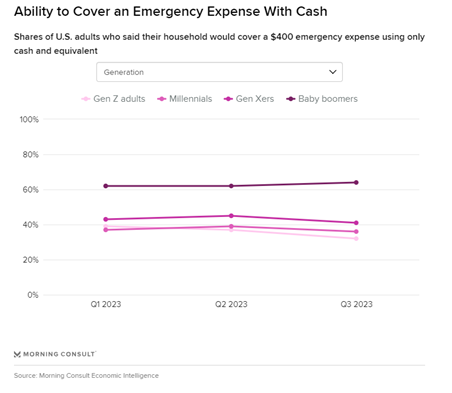
#Bidenomicsfail: Just 1 in 3 Gen Zs Say They Can Handle a $400 Emergency Expense


Joe Biden wants us to think that the economy is doing great.  In fact, the Biden economy has large numbers of Americans living on the edge. 

Morning Consult survey found that only 32 percent of Gen Z report that they could pay for an unanticipated emergency expense with cash.  Just two quarters ago, 39 percent of Gen Z could handle a $400 emergency expense. 

The normal pattern of saving over one’s lifetime is that as one ages holdings of financial assets should grow as one saves for retirement. 

However, the Morning Consult survey shows that Millennials and Gen X are making very little progress in building wealth.  

The survey found that only 36 percent of Millennials and 41 percent of Gen X said that they could handle an unanticipated $400 expense.  These percentages are not materially different from Gen Z. 

Seen differently, Gen Xers are now more than twenty years into their adult lives and their finances are not much more stable than the finances of new college graduates. 


The survey also asked whether the $400 expense would require putting off payment of other bills.  38 percent of Gen Z and 39 percent of Millennials and Gen X would have to put off payment of other bills. 

It’s not just Americans.  A video posed by TikTok user Simone (@simonesdays) shows how after paying taxes and bills, the paycheck from her CAD75,000 corporate job leaves her with exactly in $80 spending money for the next two weeks. 

Her TikTok video has been viewed 2.7 million times and has 184,000 likes as of Friday the 4th. 

Here are some of the comments on her TikTok page from other young people struggling to get by. 


At the core of the financial struggles of young A


mericans is a lack of economic opportunity.  The inability of the Millennials and Gen X to improve their finances so that they are closer to the Baby Boomers than Gen Z is particularly concerning.

Sunday, February 26, 2023

WSJ: Young Americans Being Driven Deeper into Debt


The Wall Street Journal documents how inflation, rising home prices, and fallout from COVID are driving young Americans deeper into debt.  One wonders how long they’ll keep voting for the politicians that are impoverishing them.

The Wall Street Journal reports that debt levels and credit card delinquencies are rising more rapidly among young Americans than any other demographic group.

The article cites three factors, all of which have their basis in government policies. 

First, there is inflation, a creation of frenzied Federal Reserve money creation.  The Journal writes:

“Now, rapid inflation is forcing many to spend more on gas, groceries and rent, eating into pandemic savings. The last round of stimulus checks went out in 2021. Families are back to commuting, traveling and eating out again. The Federal Reserve’s campaign to curb inflation has pushed up interest rates on credit cards and other types of loans.”

Then there’s COVID.  The Journal points out that families had to spend a lot more on child care when schools were closed—and teachers given paid vacations—during the pandemic.  The Journal writes:

“Some changes are hurting millennials in particular. Many spent unplanned thousands of dollars on child care or tutoring when schools closed. Some relied heavily on a pandemic-era program, the government’s monthly child tax credit payment, but that has lapsed.”

And third, we have skyrocketing home prices.  The Journal writes:

“Many 30-somethings are trying to buy their first homes and have been squeezed by higher rates and home prices. The median price for an existing home was $359,000 in January, more than $90,000 higher compared with three years earlier. In recent years, prices rose the most in lower-cost neighborhoods that are more likely to be in millennials’ budget range.”

The factors that lead to home price inflation can all be traced back to government policy in some form.

 The Federal Reserve’s free money policies of the last fifteen years did nothing for home buyers.  Sure, you could get a mortgage on the cheap.  But that also meant that there was a lot of competition among buyers so sellers could get a high price. 

On balance, low rates did nothing for home buyers.  Home ownership rates for young people didn’t go up during Bernanke, Yellen and Powell’s decade and a half of monetary madness.     

Couple that with NIMBYism and zoning restrictions that make it very difficult to build new homes because that’s no land.  As Mark Twain said about land: “they ain’t making any more of it” and as long as local governments won’t allow greater density, they ain’t making more homes either.

Unfortunately, the Baby Boomers and Gen Z have proven slow to learn that government is the source of, not the antidote, to their problems.

As long as young people keep voting for more government, they’ll continue to get the shaft, and go deeper into debt to make ends meet.

Thursday, December 2, 2021

New Harvard Youth Poll Out

Results of the fall 2021 Harvard Youth Poll are now out.  I'll be commenting on the results in future blog posts.  

Many young Americans are in a pessimistic mood.  

Approval of the Biden Administration is down.  Young people are divided on whether the Biden Administration is a failure or if it is too early to tell.

This round of the poll asked a large number of questions concerning the level of anxiety that young people feel regarding the future of our country and whether democracy is working.

Researchers also asked about the willingness of young Americans to serve in the military if they were called up.   

The Harvard Survey provides an extremely useful tool for taking the pulse of young Americans.